
From Rewiring Taste to Navigating Ambiguity: What Neuroscience Taught Me About Building Products
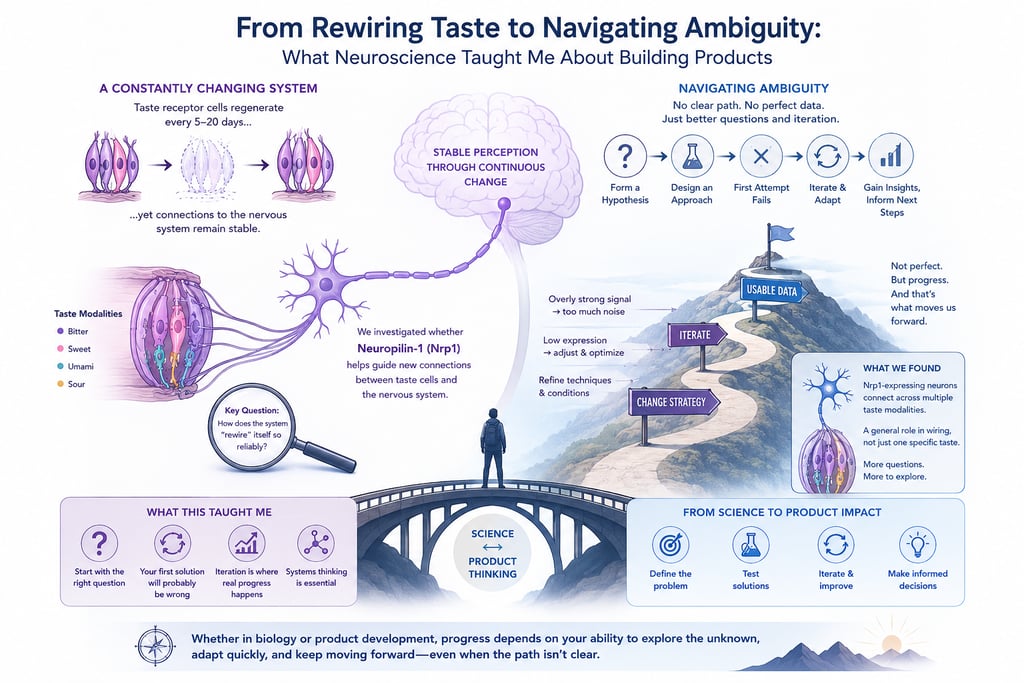
When I first started studying neuroscience, I was fascinated by a deceptively simple question: how do we taste? We investigated whether Neuropilin-1 (Nrp1) helps guide new connections between taste cells and nervous system
When I first started studying neuroscience, I was fascinated by a deceptively simple question: how do we taste?
It turns out, the answer is anything but simple.
Taste is not just about receptors on the tongue detecting flavors—it’s about a complex, dynamic system of communication between short-lived taste receptor cells and long-lasting neurons that transmit signals to the brain. What makes this system especially intriguing is that taste receptor cells regenerate every 5 to 20 days. Despite this constant turnover, the connections to the nervous system remain stable.
That raised a fundamental question:
How does the system “rewire” itself so reliably?
The Problem: Stability in a Constantly Changing System
In most biological systems, stability depends on consistency. But in the gustatory system, stability emerges from continuous change. New taste receptor cells must form precise connections with the correct neurons, ensuring that signals—like bitter or sweet—are transmitted accurately.
We wanted to understand whether a specific molecule, Neuropilin-1 (Nrp1), played a role in guiding this process. Previous studies suggested that related signaling pathways might influence how taste qualities like bitterness are wired. However, there was no clear evidence for how Nrp1 functioned in this context.
This wasn’t a well-defined problem with a clear path forward. It was ambiguous, complex, and difficult to measure.
Forming a Hypothesis
We hypothesized that Nrp1-expressing neurons might help guide connections between taste receptor cells and the nervous system—potentially playing a role in maintaining correct wiring as cells regenerate.
To test this, we needed to:
Identify where Nrp1-expressing neurons were located
Trace how they connected to taste receptor cells
Determine whether they showed preference for specific taste modalities
Designing an Approach (and Learning It Wouldn’t Be Perfect)
We used transgenic mouse models to label Nrp1-expressing neurons and attempted to visualize how these neurons innervate taste buds. To distinguish between different taste modalities, we labeled separate populations of taste receptor cells—grouping bitter, sweet, and umami cells together, and comparing them against sour cells.
The idea was straightforward: if Nrp1 played a specific role (for example, in bitter taste), we would expect to see preferential connections.
But as is often the case in research—and in product development—execution is where complexity emerges.
When the First Approach Fails
Our initial strategy relied on strong genetic labeling techniques. In theory, this would clearly highlight the neurons we wanted to study.
In practice, it didn’t work.
The signal was too strong, overwhelming the system and making it difficult to distinguish meaningful patterns. Instead of clarity, we got noise.
At this point, we had a choice:
Continue refining a flawed approach
Or step back and rethink the strategy
We chose the latter.
Iteration: Changing the Strategy
To overcome the limitations of our initial method, we shifted to a viral labeling approach. This allowed for more controlled and selective labeling of neurons.
But even this required iteration:
Early attempts didn’t produce sufficient expression
We adjusted recovery times
We refined injection techniques
We optimized experimental conditions
Gradually, these changes started to work. We began to see labeled Nrp1-expressing neurons and their projections into taste buds.
It wasn’t perfect—but it was usable.
What We Found
With improved labeling, we were able to observe how Nrp1-expressing fibers interacted with taste receptor cells.
Interestingly, these neurons did not appear to associate exclusively with one type of taste cell. Instead, they showed connections across multiple categories, including both sour and other taste modalities.
This suggested that Nrp1 might play a more general role in wiring rather than being specific to a single taste quality.
However, the data was still preliminary. To draw definitive conclusions, further quantitative analysis and additional experiments would be needed.
Impact: Progress Over Perfection
At first glance, the results might seem inconclusive. We didn’t definitively prove a specific role for Nrp1 in a single taste pathway.
But the impact of the work was still meaningful:
We established a viable experimental framework for studying neural wiring in taste systems
We identified limitations in existing approaches and developed improved methods
We generated early insights that informed future research directions
In complex systems, progress often comes from refining the questions as much as answering them.
What This Taught Me
Looking back, this project shaped how I approach problems far beyond neuroscience.
1. Start with the right question—even if the answer isn’t clear : Not all valuable problems are well-defined. Some of the most important ones require working through ambiguity.
2. Your first solution will probably be wrong : Initial approaches rarely work as expected. What matters is how quickly you recognize limitations and adapt.
3. Iteration is where real progress happens : Each failed attempt wasn’t wasted effort—it was information that guided the next step.
4. Systems thinking is essential : Understanding how different components interact is often more important than analyzing them in isolation.
From Science to Product Thinking
What I didn’t realize at the time was that I was already practicing a mindset that closely resembles product development:
Forming hypotheses → defining problems
Designing experiments → testing solutions
Iterating on methods → improving products
Interpreting results → informing decisions
Today, as I transition into product management, I see this experience differently.
This wasn’t just a neuroscience project.
It was an exercise in navigating uncertainty, making data-driven decisions, and continuously iterating toward better outcomes.
Closing Thought
The gustatory system is still full of unanswered questions. How exactly the brain maintains stable perception despite constant cellular turnover remains an open area of research.
But working on this problem taught me something broader:
Whether in biology or product development, progress depends on your ability to explore the unknown, adapt quickly, and keep moving forward—even when the path isn’t clear.